 島根大学医学部眼科学講座
S-SPRING Camp September 2026: Learning, Sharing, and Connecting
2026.09.10-12
From September 10-12, 2026, I participated in the S-SPRING camp at the Tamatsukuri International Hotel Rivage Choraku in Matsue, Shimane.
This camp is a regular activity for S-SPRING students, usually held twice a year around March and September.
Although the camp has been organized many times before, it was my first time participating.
Eighteen students from the Matsue and Izumo campuses of Shimane University joined the program,
with participants coming from Japan, Bangladesh, China, Vietnam, and Indonesia.
Given the participants' diverse research fields, cultures, and experiences,
the three-day camp provided a valuable opportunity to learn new skills and get to know other S-SPRING students.
On the first day, Dr. Todd James Allen,
an associate professor at Kansai University's Faculty of Foreign Language Studies whose academic fields include sociopragmatics,
intercultural communication, and academic writing, led a workshop.
He introduced practical ideas on designing effective presentation slides and communicating a message clearly, especially when time is limited.
This prepared us for the three-minute research presentations the following day,
in which we had to explain our research in a way that people outside our fields could easily understand.
In the evening, we had a counseling session with Professor Yoshiki Saito from the Estuary Research Center (EsReC) at Shimane University.
We discussed the progress of our S-SPRING mentoring and internship activities, shared our experiences, and talked about our future plans.
The second day began with the three-minute research presentation, which was arguably the most interesting and challenging part of the camp.
Each participant had three minutes or less to present their research in a way that could be understood by a general audience or researchers from different fields.
After each presentation, we received feedback from Dr. Todd Allen and the other participants.
The comments covered many aspects, including speaking style, storytelling, choice of words, time management, and slide design.
Since we came from different academic backgrounds,
feedback from the other participants was useful in determining whether our research message was understandable outside our own fields. After lunch,
we had a group meeting where students from different countries, campuses, and research areas presented their work in smaller groups.
This more informal setting encouraged questions and discussion, giving us a chance to learn about research topics far beyond our own specialties.
Later that afternoon, we attended a career session with Dr. Narendra Sarda, who is currently the Global Talent Acquisition Lead at Kanadevia Corporation in India.
Before developing his professional career in Japan, he earned his Ph.D. in a field related to life and material science/chemistry at Tokushima University in Japan.
Dr. Sarda shared his career journey, his experience working in Japan, and practical advice for international students looking for jobs.
One message that stood out was the importance of language and communication skills.
While academic knowledge is important, being able to communicate ideas, adapt to different environments,
and connect with people can be equally important for building a professional career, especially in Japan.
That evening, the atmosphere became much more relaxed as we spent time with Professor Saito and the other participants,
talking about research, life in Japan, our home countries, and many other topics.
These informal conversations were an important part of the camp, allowing us to get to know one another as both researchers and friends.
On the final morning, Dr. Sarda led another workshop based on Stephen R. Covey's The 7 Habits of Highly Effective People.
The session encouraged us to consider how our daily habits influence the way we work, communicate, set priorities, and pursue our goals.
Although ideas such as being proactive, beginning with a clear purpose, putting important things first,
seeking to understand others before expecting to be understood, creating mutually beneficial relationships,
working through synergy, and continuously improving ourselves may sound simple,
the workshop helped us consider how to apply these habits to academic and professional life.
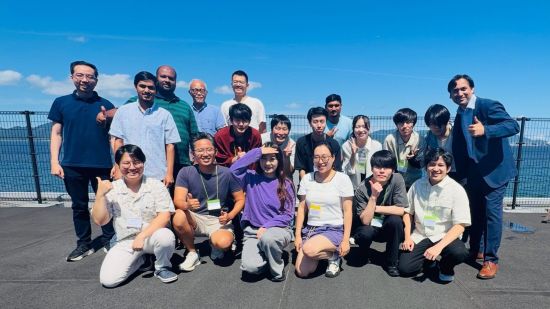
After three days filled with presentations, discussions, workshops, and conversations, the September 2026 S-SPRING Camp concluded with a group photo.
For me, my first S-SPRING Camp was an opportunity not only to learn how to explain my research in three minutes but
also to see research from different perspectives, think more seriously about life after completing my studies,
and build connections with students from different fields and countries.
One of the simplest lessons I took away from these three days is that good research needs to be communicated through a good story.
Arief Abdurrazaq Dharma
Department of Ophthalmology, Shimane University Faculty of Medicine
S-SPRING Fellow, supported by the Japan Science and Technology Agency (JST)